
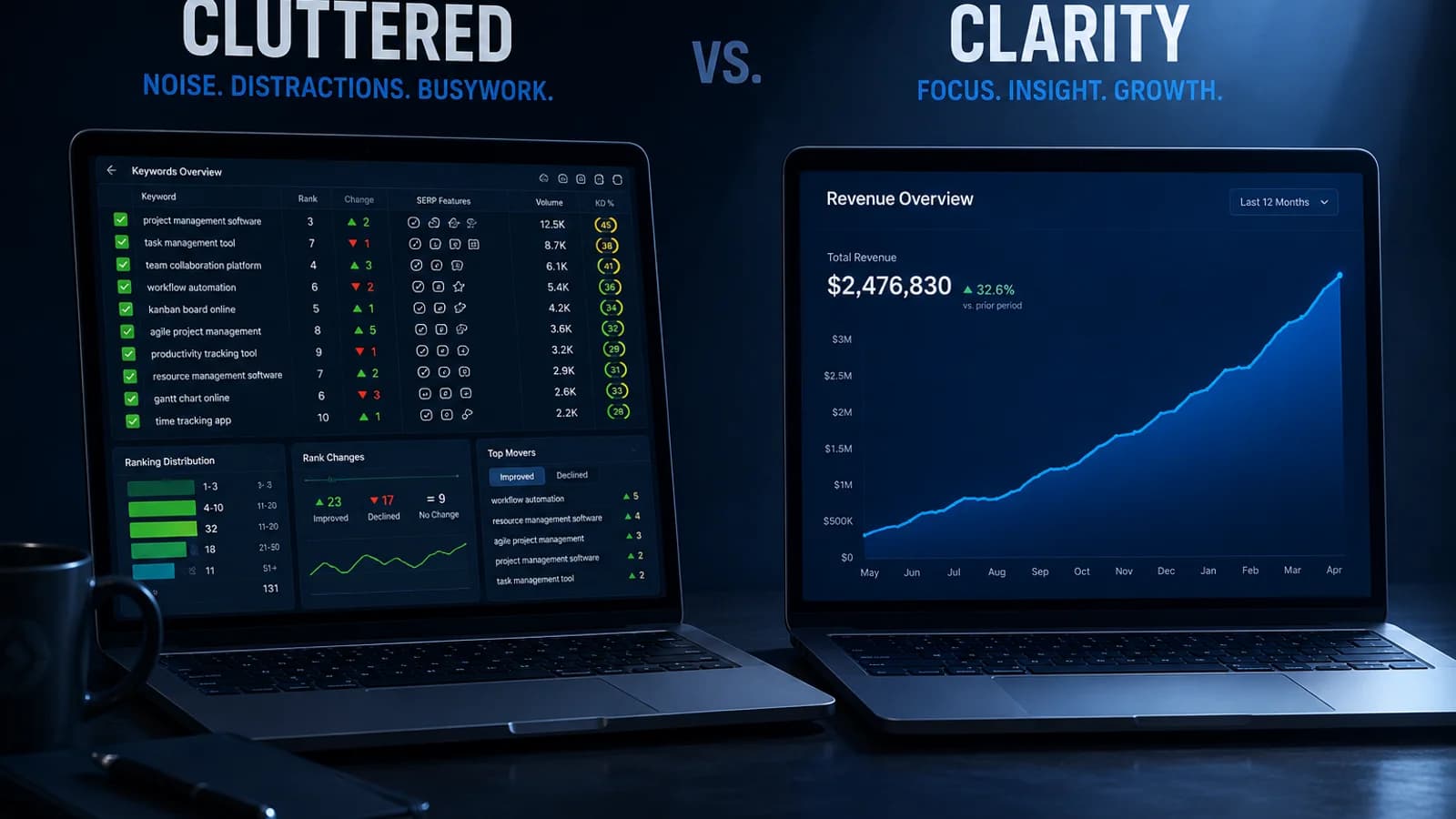
Why Most SEO Is Sold on Activity, Not Outcomes
Open a typical SEO agency's monthly report. You'll find a long list of tasks completed, a screenshot of a few keywords moving up the rankings, a paragraph about technical fixes the agency made to your site, and a chart showing organic traffic that may or may not have changed. The agency feels productive. The client feels reassured.
None of those things are what the client is paying for.
The client is paying for one of three things: more qualified visitors to their website, more of those visitors becoming customers, or more revenue from those customers. SEO is the mechanism — rankings and traffic are the proximate signal — but the actual product is commercial. Yet most agencies don't report on the commercial product. They report on the mechanism and the signal.
This is the gap that defines the SEO services market. And it persists because the gap is comfortable for both sides.
Why the gap is comfortable
For the agency, activity is easy. Activity can be reported every month — there will always be tasks, rankings, technical fixes, content pieces. It looks like value being delivered, every month, regardless of whether anything is actually moving.
Outcomes are hard. They take longer to materialise. They're affected by factors outside the agency's control — the algorithm, competitors, the client's own product and pricing. They require connecting work to revenue, which means having systems for measuring revenue and the discipline to be honest when the answer is "we don't know yet" or "nothing is moving."
An agency that reports activity is never embarrassed. An agency that reports outcomes is regularly uncomfortable.
For the client, activity feels reassuring. You opened the report; lots happened. You didn't have to ask hard questions. The agency seems busy and competent. The relationship feels good even when the underlying value is unclear.
Outcomes force harder conversations. If outcomes aren't moving, someone has to say so. The relationship gets uncomfortable. The client has to make decisions — keep going, change tactics, change agencies. Activity-led reporting protects both parties from that discomfort, which is exactly why it persists.
The cost of activity-led reporting
The cost lands on the client. Every month of activity-led reporting that doesn't connect to commercial outcomes is a month where the client doesn't know whether they're getting value. They make renewal decisions on feel rather than evidence. They invest more in a channel that may or may not be working. They miss the warning signs that would tell them something needs to change.
Eventually one of two things happens. Either the agency happens to produce real commercial results despite themselves, and the relationship continues. Or the client realises — usually six or twelve months in, often during a budget review — that they can't actually show what the engagement produced for the business. At that point the relationship usually ends, but late. The opportunity cost of those months is enormous.
For the agency the cost is reputational, eventually. Agencies that build their model on activity-led reporting have lower retention, higher churn, and a constant need for new business — because as soon as clients look closely at the value, the relationship breaks. A small market like the Gold Coast remembers which agencies' work didn't hold up.
What outcome-led reporting looks like
A good monthly report leads with the question the client actually has: is organic search contributing to my business, and which way is it heading? It answers that question first, in a sentence, in plain language. Then it tells the story of the month — what changed, what moved, what connection there was between the work the agency did and the results that landed. Then it's honest about what didn't move and why. Activity comes last, as supporting detail behind the story, not as the headline.
The report is delivered in a conversation, not just an email. The conversation is where questions get asked and the relationship gets maintained.
This is harder to produce than an activity report. It requires the agency to actually know what's working and what isn't. It requires honesty when the answer is uncomfortable. It requires connecting the work to the revenue — which means having access to the client's analytics, conversion data, and ideally their CRM, and treating those as primary measurement sources rather than the agency's own task tracker.
It's also the reason a small number of agencies retain clients for years and most don't.
What to demand
If you're hiring an SEO agency: ask them, in the sales conversation, what their monthly report leads with. Ask to see an example report from an existing client. If the report leads with the commercial picture — qualified traffic, leads, customers, revenue — and treats activity as supporting detail, you're talking to an agency that thinks about its work the right way. If the report leads with ranking screenshots and a task list, you're talking to an agency that will report activity to you for as long as you'll let them.
You can also test this in the first month. Ask the agency: "Show me how the work you did this month connected to our commercial outcomes." A good agency will answer specifically. A bad one will retreat to "SEO takes time" and produce more activity for the second month.
The agency that takes this seriously is also the one that's comfortable having honest conversations when results aren't moving. That comfort is rare, and it's worth choosing for. Because the only thing worse than an agency that reports activity in good times is an agency that reports activity when nothing is happening — and you have no way to tell the difference.
About the author
Martin Lark
Founder, Lark Digital Studio